Alpaca & Llama Shepherdess
A homecoming
The move to camelid shepherdessing was both a surprise and a homecoming.
You know when you look back over your life and a seemingly out of place passion suddenly makes glaring sense?
This is how I felt as I found my way to herding alpacas.
I have always felt a deep affinity with animals and completely at ease in their presence but more than that, I had quite a specific obsession with animal behaviour and herding.
To the amusement and bemusement of my husband I was completely obsessed with watching sheepdog trials as a kid and living in a caravan on a sheep farm with the field directly outside of our living room and bedroom windows for nine years, I got to watch herding 'live' often.
I often felt as though I were a shepherd(ess) without a flock, a herdswoman without a herd.
And then... I, quite unexpectedly, found my flock, happened upon my herd and an unexpressed part of myself found an outlet.
I found home, healing and meaning amongst the alpacas.

How it all began
In the summer of 2024, when my daughter was just two, I began taking care of a herd of thirty six alpacas.
The work with my daughter on my back opened up a connection with these beautiful animals beyond just their daily care.
I became aware of the similarities between these timid, curious and intuitive prey creatures and humans who had experienced challenges.
I trained in CameliDynamics (read more below) and saw how treating these creatures with the respect they deserve opens something in the human heart.
How offering animals choice and allowing them to consent allowed me to understand my own need for these things more deeply.
How profound it feels to gain the trust of a nervous animal.
How liberating it is to let them be who they are without wanting them to be anything else.
How completely right it feels to handle them in a gentle, respectful and consent based way.
Spending time with the alpacas offered a gentle healing which I didn't go looking for.
And in advocating for their needs, I began understanding how to advocate for my own.
I spent two years offering experiences with the alpacas for enjoyment (because they are such funny little lovely things) and wellbeing (because they offer such gentle healing) at Hideaway Wood Farm before my life turned upside down and I found myself without animals again.
I knew I wanted to get back to the land but it seemed impossible. I dreamed of my own little fibre herd but I couldn't see how I could make it happen.
And then a phone call. Some llamas and alpacas to call my own and some land for them too. A dream come true.

Falling in love with llamas
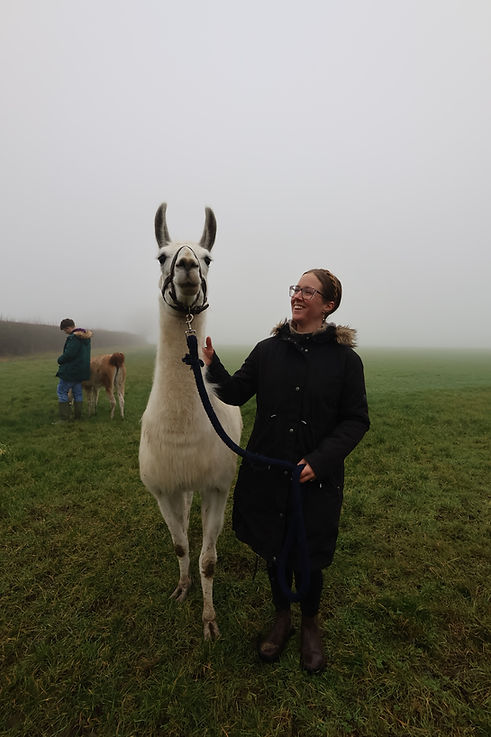
I met my first llama, Quinn, in January 2025 after talking about little else for about three months.
My husband bought me a llama trek voucher as a Christmas present and I emailed to book it in on Christmas morning at 8am.
The build up to meeting my first llama was intense.
I saw a photo in a book about camelid handling that I was reading and thought of little else from then on. And it didn't disappoint.
It was love at first sight.
I shed tears as he walked out. Actual tears.
And I just felt so safe with him. He was so tall and imposing and calm and steady. Walking beside him I felt so at peace.
And I craved that feeling when we were apart. I knew that one day llamas would be a part of my life, somehow!
I realised that when I'm with alpacas I feel as though I'm taking care of them but when I'm with llamas I feel as though they're taking care of me.
I started trying for our next baby and in protection said to myself if I can't have a baby, I'm getting a llama.
And so after three pregnancy losses in a year, my llamas (and alpacas!) found me.
Miguel, Jiminey and Luca. Together with their alpaca friends Prince and Elvis.
Originally from the wonderful Nikki of The Llama Experience, courtesy of the power house that is Mary & the wonder that is Sarah at Catanger Llamas.
These beautiful boys now form my very own fibre herd. A thing of dreams. Forever grateful x

CameliDynamics
What is it all about?
There's an amazing woman called Marty McGee Bennett who has worked with South American camelids (llamas and alpacas in terms of domesticated species, originating from vicuñas and guanacos in terms of their wilder cousins) for over thirty years.
In her words it is, 'a collection of methods that represent the most positive least intrusive techniques for training and managing camelids'.
It's truly beautiful work. It's all about understanding their behaviour and why they react in certain ways. The approach requires that we pay a lot of attention to our own body language, movements and behaviours too. It requires complete presence.
The idea is that we move from the traditional method of cornering, grabbing and restraining to allowing the animal their escape route, slowly desensitising them to our proximity and helping them to remain in balance whilst we work with them.
Alpacas and llamas are generally much more fearful of being grabbed and restrained than they are of the husbandry work we need to do.
When we stop doing those things they can learn to stand calmly in balance whilst we work instead of trying to buck us off and escape.
________________________
Toenails no longer required a team
I began by trialling it out on some of the most troublesome girls I was in charge of in the autumn of 2024. They were under handled, nervous and skittish making husbandry tasks harder to accomplish.
I was taught that it took three people to pin an alpaca down to do a simple husbandry task like toenails, vitamin paste or vaccinations.
Within a few handling sessions their responsiveness to the technique and the increase in their trust showed us how effective and most importantly, respectful of their unique nature CameliDynamics is and so we rolled it out across the herd.
Within a couple of months of not grabbing them, I was single handedly conducting herd health checks and inoculations and toenails no longer required a team.
At first we wondered if it might slow us down and make things harder but in fact it made us much more efficient and I felt good about the fact that we were treating our animals with the respect, autonomy and kindness they deserve.
It became a significantly calmer experience for the animals and for us too.
I began to genuinely look forward to health check day rather than dread it.
________________________
Pouncing like leopards
We are taught to sneak and pounce like leopards which understandably makes our animals edgy.
Alpacas are incredibly sensitive and intuitive, I saw over the years that they knew my intentions.
So I harnessed that. I gave them visual cues of what I was coming to do, I used the same language to train them to my words. These simple changes changed the nature of my work.
I didn't hide anything from them and they were calmer for it. They knew what was coming and what to expect.
And the most important tool in the box? My regulation.
If I headed into the handling pen time pressured, stressed, frustrated or low in tolerance they knew. And it was absolutely pointless trying to do anything. So I often walked away or tried to shift my state.
I realised over time that the crossovers between yoga, meditation and CameliDynamics are huge; presence, breath, body awareness and awareness of environment are all essential to being able to use this technique effectively. If we're aware of our bodies and responses the animals are more likely to settle in our presence.
________________________
My Training
In February 2025 I took a CameliDynamics Handling and Animal Assisted Activity (AAA) course with senior CameliDynamics consultant Victoria Barrett of Simply Alpaca.
